
COLUMN: The credit market and the convenient illusion of personal responsibility
The credit market loves the story of the irresponsible individual. But what happens when the entire system is designed to induce the very decisions for which we then judge people?
We love the story of the irresponsible borrower. Someone took a loan they shouldn't have taken, lived beyond their means, or borrowed money at the click of a button that they didn't actually have. Then come the consequences, and swiftly the judgment follows: you only have yourself to blame.
It is a story that suits the credit market suspiciously well.
Because while the individual is expected to answer for every misstep, the loan industry is surrounded by a strange kind of immunity. Companies that profit from people's financial vulnerability are portrayed as neutral intermediaries, almost as if they just happened to be standing there when someone desperately needed money. As if credit emerged in a vacuum, without design, without psychology, and without calculation.
That is not what reality looks like. Today, loans and credit are sold through systems that are fine-tuned to bypass the exact mental barriers that otherwise protect people from bad decisions.
Credit feels less dangerous when it is broken down into small monthly amounts. Debt feels less real when the total sum is hidden behind words like "flexible repayment." Loan feels less like a debt when it is presented as freedom, financial breathing room, or a secure safety net. The brain reacts to stories faster than it reacts to mathematics. And the industry, of course, knows this.
Modern organizations systematically create a moral distance between action and consequence. Faces are replaced by numbers, and people are set to categories, risk profiles, and customer segments. When a human being becomes a credit score in a system, it also becomes easier to make decisions without moral friction. No one needs to see the concrete individual behind the debt anymore, only the repayment rate, the margin, and the profitability.
It is also an effective way to avoid feeling. When people become data points, something happens to the way we think about them. A person sitting with anxiety over their finances becomes a "risk level." An uncertain future becomes a "probability." A difficult life situation becomes a "business opportunity." It sounds cynical, but it is really about structure. And structures are peculiar in the sense that they can produce consequences for which no single actor feels responsible.
The person designing the loan product optimizes conversion. The person writing the copy improves the customer journey. The person setting the interest rate model works with business logic. Everyone is just doing their job. And because of that, an entire system can be built around exploiting human weaknesses without anyone having to feel like an exploiter.
This is why this market is rarely perceived as immoral from the inside. Everything looks rational and can be justified. And thus, the whole picture becomes harder to question. It is the morality of organizational efficiency in practice.
We like to talk about the individual's free choice, but "freedom" is a strange word in an environment where the entire architecture is built to reduce resistance. When companies test which phrasings get more people to accept loans, which colors increase click-through rates, and which interfaces shorten thinking time, it becomes debatable whether services are being sold, or if decisions are being induced.
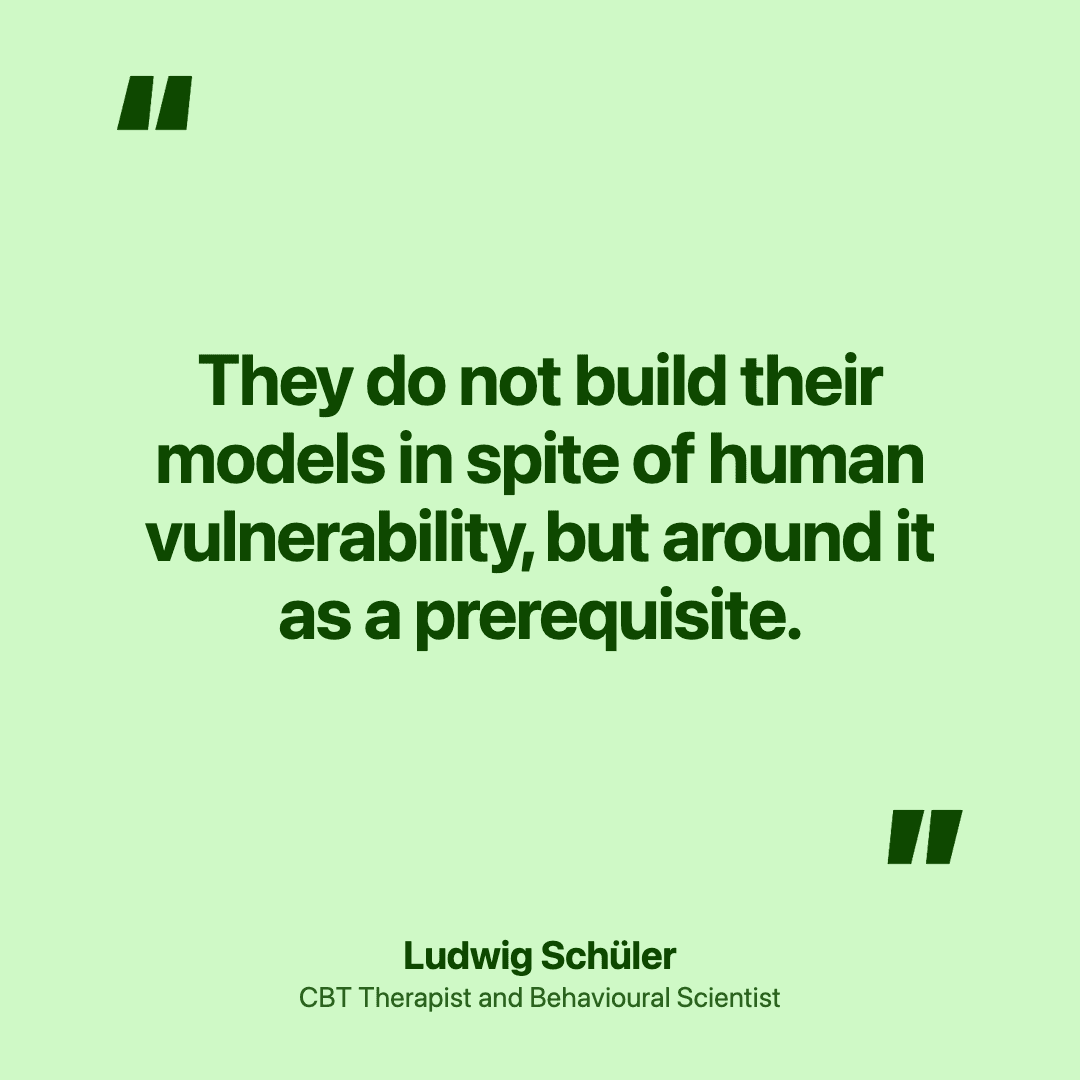
Human beings are not calculators. They take out loans when they are stressed, pressured, scared, and tired. They do it when the fridge breaks down, when the rent is due, and when life doesn't follow the budget. And the credit companies know this. They do not build their models in spite of human vulnerability, but around it as a prerequisite.
This does not mean that people are irresponsible, but rather that we tend to consistently place responsibility in the only place where it is safe to do so. The individual can carry the shame, while everything else can continue as usual.
Ludwig Schüler
CBT Therapist and Behavioural Scientist
…
Ludwig shares more perspectives on behaviour and psychology on Instagram: @schuler.kbt